Can stacking Mac Minis really run advanced AI?
Since posting more regularly online, I've started receiving quite a few DMs about what's happening with Mac Minis. Why are people buying them, and what does it have to do with AI? Let's dive in. I'll break down what a Mac Mini traditionally does, the problem it used to solve, and why people bought them, before sifting through the AI hype. Finally, I'll tell you whether you should go out and buy one, or consider an alternative.
The Traditional Use of Mac Minis
The typical reason people used to own Mac Minis was for creative tasks such as editing high-resolution video. They offered a viable alternative to building your own custom computer with a GPU, if you wanted to remain within the Apple ecosystem. Many people simply liked the Apple experience and wanted a machine that could handle highly intensive tasks straight out of the box.
The AI Angle
Then people realised that if they possessed the hardware to edit things like 8K video, they probably also had the hardware to run AI models, which is true, but with a caveat. Mac Minis can run something like an open-source Chinese model with a few billion parameters relatively well. However, these models have two downsides. Firstly, the AIs are nowhere near as powerful as cloud models like Anthropic's Claude or OpenAI's GPT. Secondly, if you download a local open-source model, your AI will only be able to perform one task at a time, as opposed to running multiple tasks in parallel, which significantly hinders productivity.
Why Buy a Mac Mini for AI?
So, it's not as though you end up with an army of AI agents that go out and do your bidding. If you buy a Mac Mini and run an AI agent locally, you're getting something that is, at best, 80% as good compared to the cloud models, and it can only perform one task at a time. So why would anyone do this? Some might argue that, for their particular use case over time, it works out cheaper, but I think that's unlikely. The other reason is that if you run the model locally, it's your data; it's secure; you're not giving anything away to these cloud companies, and you can do some slightly more interesting things with it because some of the guardrails are off.
The Mac Advantage
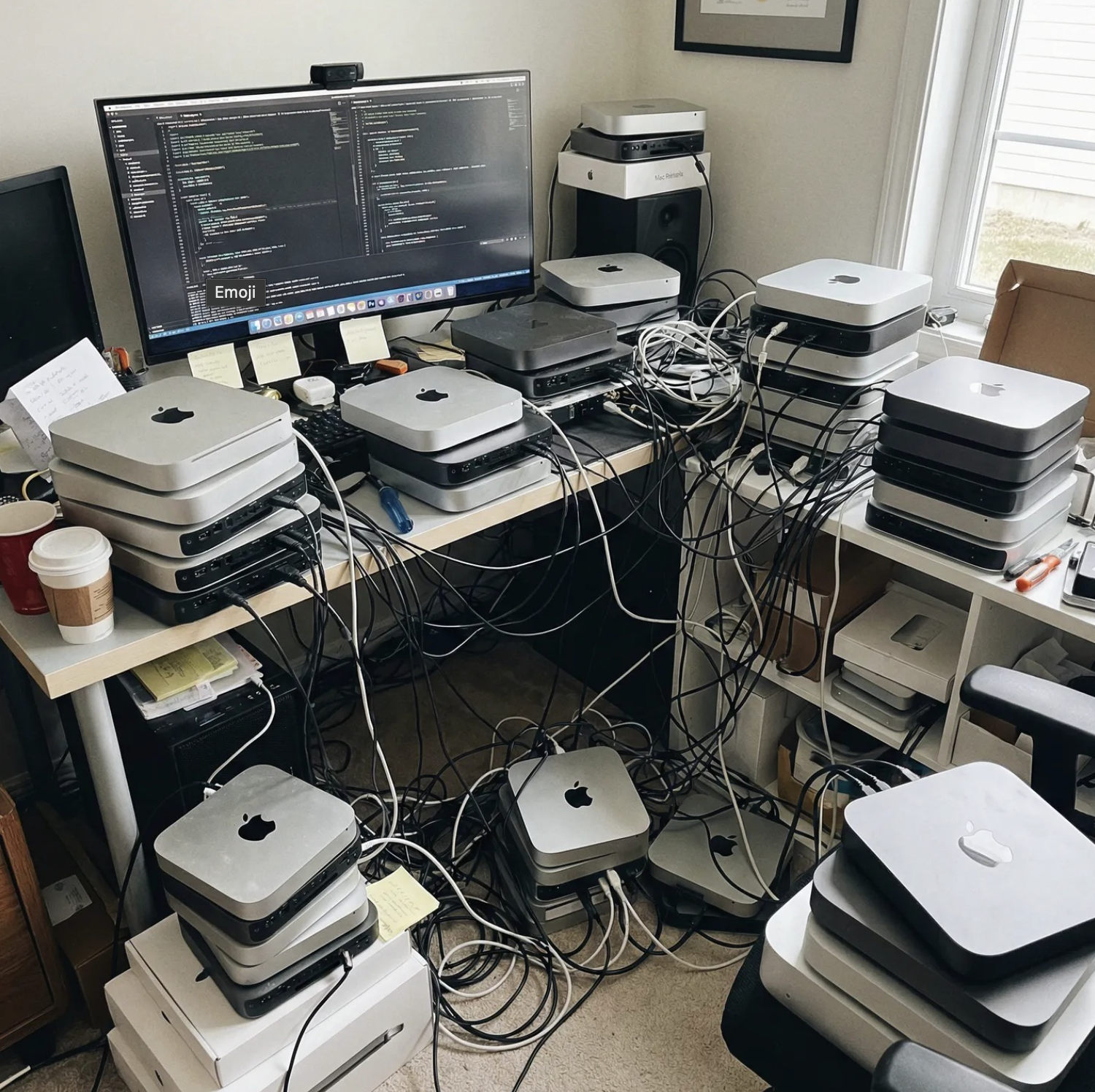
Much of the hype stems from people posting videos showcasing stacks of Mac Minis running a swarm of AI agents. For the most part, this is marketing. It looks cool, but it's incredibly expensive. In a traditional PC, running a large AI model requires a beefy GPU with ample VRAM (Video RAM), and a significant investment, as GPUs are costly. Furthermore, you need time to spare, as you typically have to assemble the entire system yourself. If the specifications are incorrect, performance will run at a snails pace. Mac Minis work straight out of the box, but to perform well, you need a top-end spec Mac Mini, costing around £4,000 each. However, they are unique in that they have a native feature allowing you to chain together their processing power. By doing this, you can start to consider running larger models and AI swarms locally, with the combined benefits of not surrendering your data to larger companies and owning the hardware of your tech stack. This makes it much harder for anyone to shut you down or silence your efforts. You send all your prompts to a set of machines located in your home, chained together by local fibre, instead of a set of cloud machines owned by Anthropic or OpenAI. Having said all of this, it's still not the primary reason for all the hype online... Enter OpenClaw.
OpenClaw and iMessage
OpenClaw went viral for its all-access, all-in-one software solution that connects Anthropic's Claude to everything, allowing tasks to run end-to-end autonomously. It operates with no permissions or guardrails, akin to throwing wet paper towels at a wall and hoping one doesn't delete your entire email inbox. People needed a place to run it, and many already own Mac Minis that sit at home and stay on 24/7.
But wait? I thought if I'm using cloud subscription like Claude, a Mac Mini is pointless? Yes, that's exactly correct... Almost.
Something many people in Europe don't realise is that in the USA, people don't use WhatsApp. They use iMessage, and this is a key reason for much of the hype. The hype isn't primarily because you can use a Mac Mini to run models locally; it's more straightforward than that. A Mac Mini is on 24/7 and sits in your home. When OpenClaw was released, people needed a way to communicate with Claude from their mobile phones, so they could keep it running while they were away from their computers (essentially a workaround for a forever terminal). In the USA, the main messaging platform is iMessage. So, anyone with an iPhone thought, to simply get iMessage to work with Claude... I need a Mac Mini, as Macs have iMessage, and that's essentially it. As cliché and typical as it sounds, it had nothing to do with technical engineering; it's entirely due to a social phenomenon. People are used to iMessage, Mac Minis have iMessage, and iMessage lets me speak to Claude using OpenClaw. End.
Should You Buy a Mac Mini?
So, should you go out and buy a Mac Mini? Almost definitely not. Unless you're a highly sensitive individual who wants to keep all their data secure, has a lot of money to burn, and doesn't mind that it's not quite as good as the online models, then maybe, just maybe, there's a use case. But for everyone else, it just doesn't make sense. Just use Signal, Telegram, WhatsApp, or a forever terminal instead of iMessage... Duh!
Alternatives to Consider
If you do that, there are cheaper and equally effective options available. As I mentioned, if you're using services like Claude or GPT and step away from your laptop, they cease activity while awaiting permissions or further instructions. To maintain productivity, you need to actively engage with them throughout the day. Furthermore, closing your laptop screen or disconnecting from the internet will also halt the agent's progress. To circumvent this issue without purchasing a Mac Mini, you could host these cloud agents on your own hardware or rent a server in the cloud. If you have an old laptop available, you'll avoid the costs of renting a cloud server and gain slightly more control, allowing you to simply unplug it if your AI decides to attempt an internet takeover. Alternatively, if you prefer something less bulky and without a permanently connected screen, you could purchase a very small computer, such as a Raspberry Pi, and run it from there instead. Simply plug your Raspberry Pi into your router and configure a persistent terminal, enabling you to communicate with the connected machine via mobile and keep those agents running continuously, ensuring round-the-clock productivity.
Conclusion
In conclusion, unless you're a highly sensitive individual with highly sensitive data requiring a high degree of security, you likely don't need to buy a Mac Mini. If you're a creative person who already owns one, you're probably too busy dedicating all your computing power to creative work for the Mac Mini to be useful as an AI agent anyway. However, you could leave it running when you go out, perhaps experiment with it, have some fun, and use it for background tasks while you're away from your computer. But for most people, you're better off running a cloud-based AI agent on a virtual private network, or a cheap, local compute machine at home, and establishing communication with that agent via a mobile device to maintain productivity, keeping it running 24/7.
This article was created with AI Blog Builder